


Health
The Urgent Need to Protect Women’s SRHR Amid the Ebola Crisis

Disease outbreaks affect every segment of society differently, but adolescent girls and young women are among the most vulnerable. Beyond the immediate threat of infection, outbreaks often disrupt access to essential health services, exposing women and girls to preventable health risks.
Today, many adolescent girls and young women fear visiting health facilities because they worry about contracting Ebola. As a result, they delay or completely avoid seeking essential SRHR services, including modern family planning, antenatal care, postnatal care, HIV treatment and care, and safe abortion services where legally permitted. This limited access places their health and lives at greater risk.
Uganda has witnessed similar challenges during previous disease outbreaks such as COVID-19, cholera, and conjunctivitis (“red eye”). During these emergencies, many adolescent girls experienced unintended pregnancies, while pregnant women faced complications after giving birth outside health facilities.
Others resorted to unsafe abortions because they could not access appropriate care. Women and girls living with HIV also struggled to collect their medication due to fear of visiting health centres. These experiences demonstrate how disease outbreaks can indirectly undermine women’s health and rights.
The Ministry of Health has made commendable efforts to contain Ebola through television and radio campaigns, social media, and community awareness initiatives. These messages have played an important role in educating the public on preventing the spread of the disease.
However, there remains a need for targeted communication that addresses the unique needs of women and girls. Public health messages should reassure them that essential SRHR services remain available and explain how they can safely access health facilities without increasing their risk of infection.
Clear guidance can help reduce fear, encourage timely health-seeking behaviour, and prevent avoidable maternal and reproductive health complications.
As Uganda strengthens its Ebola response, protecting women’s sexual and reproductive health and rights must remain a national priority. Ensuring uninterrupted access to essential SRHR services will not only save lives during the outbreak but also safeguard the health, dignity, and well-being of women and girls long after the epidemic has ended.
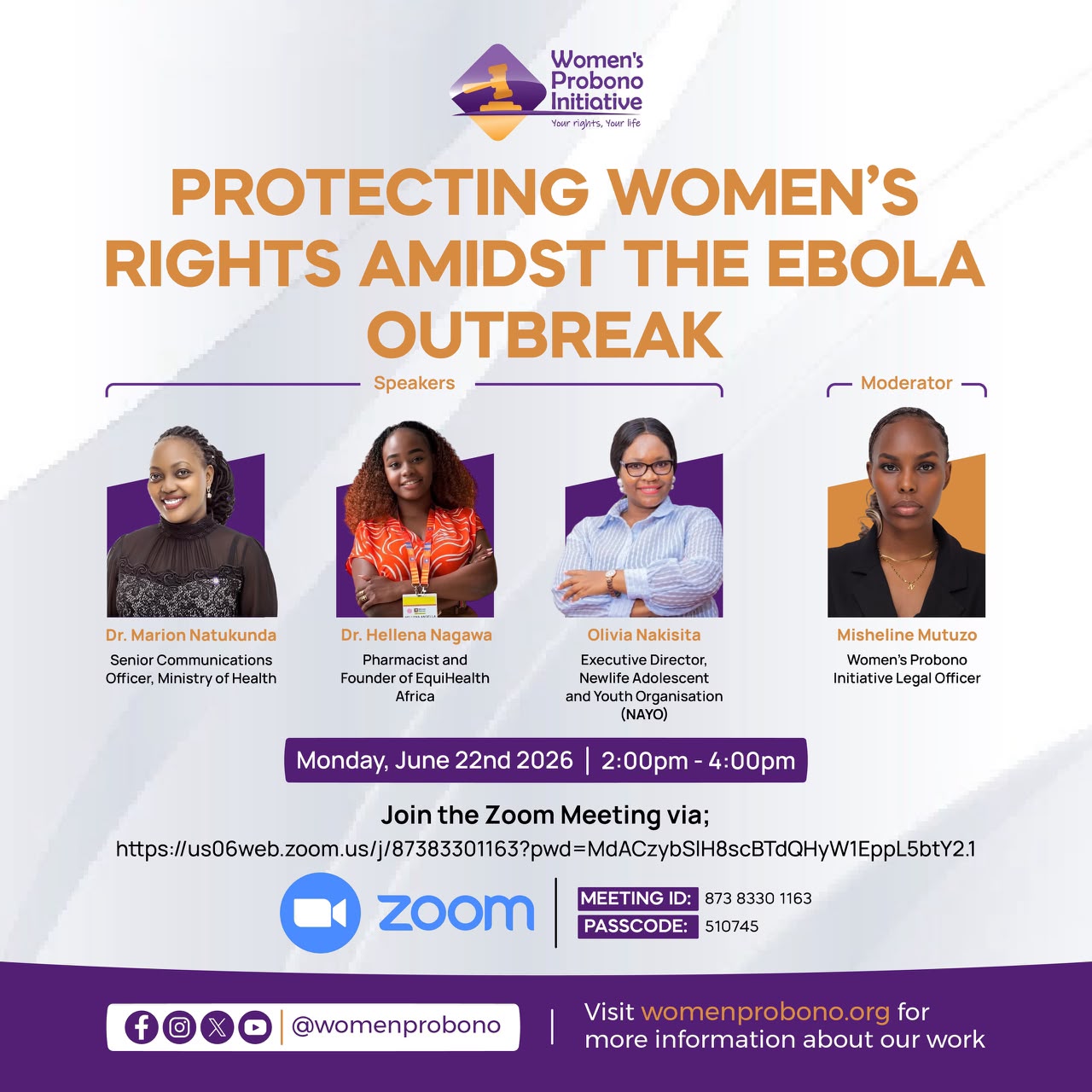
Speaking during a webinar on protecting women’s rights amid the Ebola outbreak, organized by the Women’s Probono Initiative (WPI), Legal Officer Tracy Nabbaale emphasized the need to prioritize women’s health and ensure safe access to sexual and reproductive health and rights (SRHR) services so that the outbreak does not disproportionately affect them simply because they are women.
Nabbaale noted that ensuring uninterrupted access to SRHR services during the Ebola outbreak is essential to preventing unintended pregnancies, maternal health complications, and other adverse outcomes that disproportionately affect women and girls during public health emergencies.
She further explained that disease outbreaks often disrupt access to essential services, making it critical for governments and other stakeholders to provide accurate, timely, and accessible information about the outbreak. According to her, such information empowers women and girls to make informed decisions and confidently seek SRHR services whenever they need them.
Senior Communications Officer at the Ministry of Health, Dr. Marion Natukunda, said that throughout the current Ebola outbreak, the Ministry has continued to provide safe antenatal, delivery, and other essential maternal health services at designated health facilities.
She noted that the Ministry has also worked closely with local government officials, religious and cultural leaders, and community structures to raise awareness and ensure that women and girls continue to safely access critical sexual and reproductive health services during the outbreak.
“We have put measures in place to ensure that essential sexual and reproductive health and rights (SRHR) services remain available and accessible throughout the Ebola response. Our health workers continue to monitor and follow up with women to ensure they receive safe, quality care at health facilities across the country,” she said.
The founder of EquiHealth Africa, Dr. Hellena Nagawa, noted that during epidemic outbreaks, women who often serve as primary caregivers for sick family members face an increased risk of infection while receiving limited support and protection.
Dr. Nagawa argued that women should not only be viewed as caregivers in public health emergencies but also as key partners who should be actively involved in decision-making and planning during epidemic preparedness and response, since they understand both the family and community needs.
She emphasized the importance of empowering women to participate in emergency preparedness and response efforts. According to her, this would strengthen Uganda’s capacity to prevent and respond effectively to future disease outbreaks while ensuring that the health and rights of women and girls are fully protected.
In a similar perspective, the Executive Director of New Life Adolescent and Youth Organisation (NAYO), Dr. Olivia Nakasita, emphasized that women’s health needs do not stop during disease outbreaks.
She noted that whether there is an epidemic or not, women and girls continue to menstruate, become pregnant, give birth, and require essential sexual and reproductive health and rights (SRHR) services, including antenatal care, postnatal care, family planning, and other reproductive healthcare services.
Dr. Nakasita expressed concern about the continued interaction between suspected Ebola patients, their families, and the wider community while awaiting confirmation of test results, which can take up to seven days. She warned that this delay creates significant opportunities for the virus to spread.
She further observed that, unlike previous outbreaks, it has become increasingly difficult to convince the public about the seriousness of Ebola, with some individuals remaining reluctant to adopt recommended preventive measures.
Dr. Nakasita therefore called on all Ugandans to work together in combating Ebola and other public health emergencies by adhering to prevention guidelines and supporting community efforts to curb the spread of disease.
The webinar was moderated by Micheline Mutuuzo, a Legal Officer at the Women’s Probono Initiative.