
News
Refugee youth launch ConnectRefugee App to Improve Communication in Nakivale Settlement

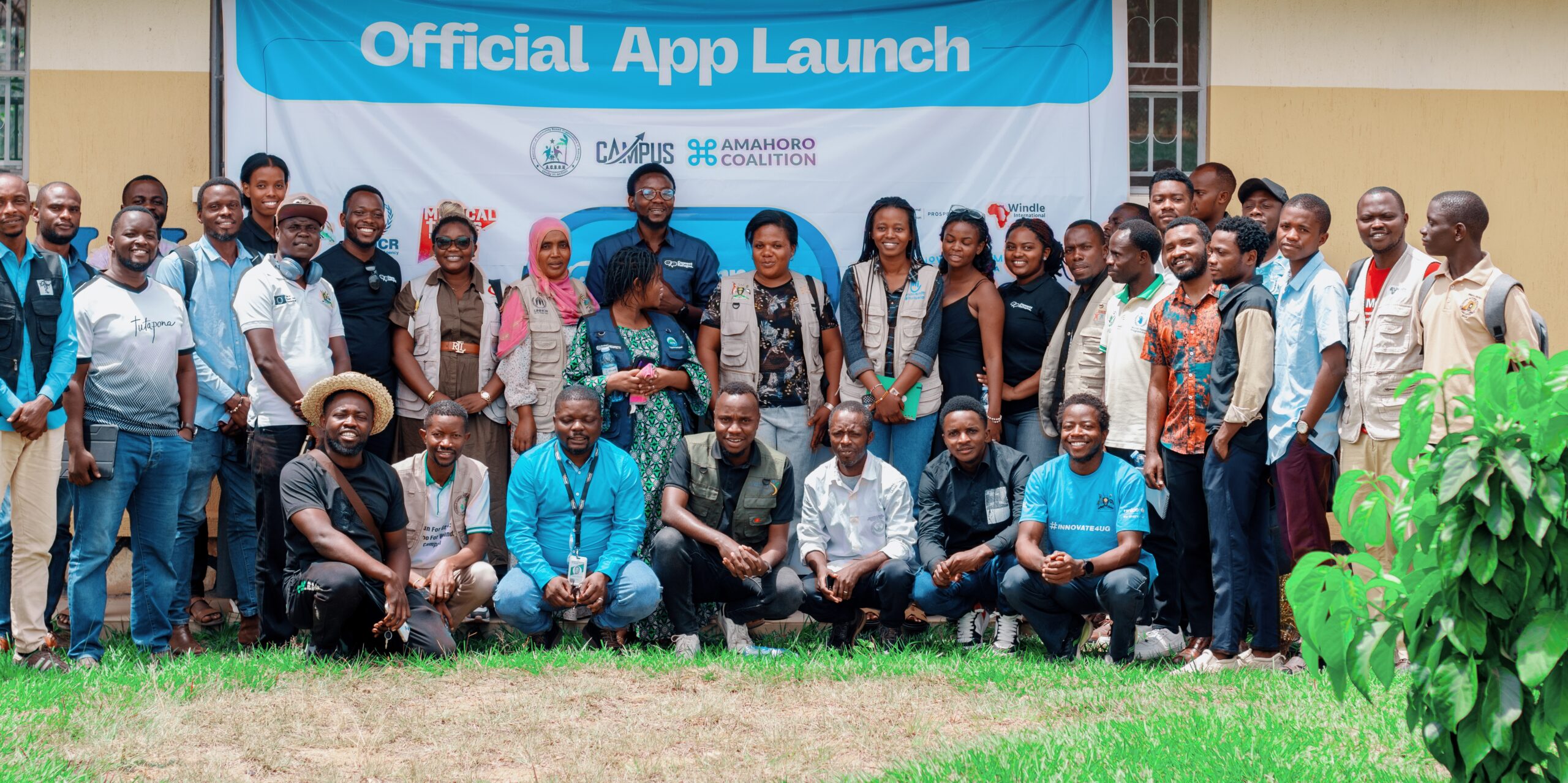
As a way of addressing communication challenges in Nakivale Refugee Settlement, on 24th/04/2026, a team of digitally-skilled youth officially launched the ConnectRefugee App, a digital platform designed to improve communication channels within the settlement and enable residents to access timely and accurate information.
ConnectRefugee was developed by Munguzo Kapera Jean, the founder of CAMPUS Digital Hub, a refugee-led technology organization operating within Nakivale that focuses on developing digital solutions to address communication and information challenges in the community.
“Instead of printing flyers, using megaphones mounted on vehicles, or relying on word of mouth to spread information, organizations can now send a single notification through ConnectRefugee App and instantly reach thousands of subscribers across the settlement.” Jean explained
For decades, the main sources of information in the settlement have been word of mouth, notice boards, water collection points, churches, mosques, megaphones mounted on vehicles, and boda boda riders announcing messages as they moved through villages.
During food distributions, registration exercises, or service changes, many residents relied on neighbors for updates while others missed the information completely increasing misinformation and confusion within the settlement.
Before the introduction of the ConnectRefugee App, false information often spread quickly whenever organizations changed policies, adjusted distribution dates, or relocated service points. Old information continued circulating long after changes had been made, leaving many residents confused and misinformed.
Rumors frequently traveled faster than official corrections, forcing residents to make important decisions based on inaccurate information. In many cases, refugees walked long distances sometimes up to forty-five minutes to distribution centers only to discover that schedules had changed days earlier without their knowledge, forcing them to return home empty-handed.
Language barriers have also remained a major challenge in Nakivale Refugee Settlement. A notice board written in English often meant little to a Congolese family that speaks only French or to a Somali family more familiar with Arabic script. Even when important information was available, many residents could not access or understand it in a language they spoke.
In addition, many residents were unaware of which humanitarian organization was responsible for specific services. When problems arose, they often did not know who to contact, where to report concerns, or how to reach support services such as the UNHCR helpline. In some cases, different organizations issued conflicting information on the same issue, leaving residents without a reliable source to verify what was accurate.
In response to these challenges, CAMPUS Digital Hub, introduced the ConnectRefugee App a free mobile application designed to deliver verified information directly to the phones of residents in the settlement.
Through the platform, registered humanitarian organizations and community bodies can send instant push notifications to subscribers. Whenever there is an important announcement, policy update, distribution schedule, registration deadline, or service change, the information is shared through ConnectRefugee App and reaches residents within seconds, helping reduce misinformation and improve access to trusted communication.
The ConnectRefugee App currently supports five languages: English, French, Swahili, Kinyarwanda, and Arabic allowing residents of Nakivale Refugee Settlement to receive information in the language they understand best. During registration, users select their preferred language, and all notifications are automatically delivered in that language.
For residents, the application is completely free to download and use. Through the platform, refugees can access timely and accurate updates from organizations operating within the settlement without having to travel long distances, rely on rumors, or depend on informal communication networks. And those who donot have smart phones easily get information from their neighbours
Jean Munguzo, revealed that the idea behind the App was inspired by a personal experience. He recalled walking nearly an hour, sometimes in the rain, to check a food distribution list only to arrive and find that the list had not been posted. He returned home empty-handed, and the experience remained with him for years before eventually becoming the inspiration behind ConnectRefugee App.
Munguzo further explained that the platform also provides humanitarian organizations with a more efficient communication channel to reach the communities they serve.
He stressed that the ConnectRefugee App was specifically designed to function on low-cost Android smartphones, which are the most commonly used devices in Nakivale Refugee Settlement.
“Organizations join the platform through a formal subscriber agreement that includes a verification process, ensuring that residents can trust the information they receive as coming from credible and recognized sources,” highlighted Jean Munguzo.
Munguzo further emphasized that Nakivale is only the beginning. According to him, refugee settlements across Uganda continue to face similar communication challenges, including fragmented information channels, language barriers, unreliable delivery of critical updates, and a persistent gap between what humanitarian organizations announce and what residents actually receive.
He reaffirmed that the team behind ConnectRefugee believes every refugee with access to a mobile phone deserves timely, accurate, and verified information just like anyone else. He said the platform is working toward achieving that vision “one settlement at a time.”
Six days after its official launch, the ConnectRefugee App was approved and published on the Google Play Store on April 30, 2026. The application is now available for download and is already operational, with humanitarian organizations and community bodies beginning to use the platform to share announcements and important updates with residents across the settlement. https://play.google.com/store/apps/details?id=com.connectrefugee.userug
According to the Chief Technical Adviser, International Labour Organization (ILO) PROSPECTS Uganda, Evans Lwanga, “Reliable information is essential for both protection and livelihoods in refugee settings. When communication depends on informal networks, misinformation can limit access to work and services. Digital platforms like ConnectRefugee help improve access to livelihoods information and strengthen accountability.”
Jean Munguzo previously served as a lead trainer on the Online Gig Work programme, a pilot initiative launched by the International Labour Organization (ILO) in 2024, which equipped over 200 refugees and host community youth in Nakivale and Kampala with digital and freelancing skills and link them to income opportunities in the global gig economy.

Implemented under the Netherlands-funded PROSPECTS partnership, which brings together multiple agencies to promote education, employment, protection and inclusive economic opportunities for refugees and host communities, the programme contributes to strengthening self-reliance, social cohesion, and access to decent work in displacement settings.
Munguzo received training from the International Labour Organization (ILO) and later became a trainer of youth on various topics designed to enhance their skills. These included personal branding, professional communication, customer relations, technical and financial proposal writing, as well as the use of artificial intelligence and other digital tools to improve productivity.
Melissa Kyeyune, National Project Coordinator for Digital Skills and Micro-work at ILO Uganda, commended Jean Munguzo for his efforts towards creating this App. “During the ILO Online Gig Work pilot, community trainers like Jean played a key role in building the skills and awareness that now underpin digital solutions like ConnectRefugee. These trainers continue to shape pathways where refugees and host communities can not only access work opportunities, but also confidently develop and navigate digital tools.” She stressed
About Munguzo Kapera Jean
Munguzo Kapera Jean is a Congolese refugee who arrived in Uganda in 2017 and taught himself technology by volunteering at an organization where his only payment was access to a laptop and the internet. He had no mentor, no roadmap, and no prior technical background. What he built from that starting point became CAMPUS, and what CAMPUS built became ConnectRefugee.
CAMPUS, which stands for Connect, Assist, Mentor, Provide, Uplift, Support, runs basic computer training for settlement residents, along with advanced courses in web development, artificial intelligence, and digital marketing. It also runs DigiLadies, a program focused on digital skills for women, and the Community Learners Project Group.