


Environment
Biodiversity Begins at Home: Mbale Dances for Nature as Uganda Marks International Day for Biological Diversity

There are official government events where people sit stiffly in plastic chairs, clap politely, check their phones every few minutes, and silently pray for lunch. Then there was the International Day for Biodiversity (IDB) 2026 celebration held in Mbale District last week. This one breathed, quite literally.
The cool eastern Uganda air swept through Bukiende Sub-County like nature had arrived as guest of honour. Not the Kampala air that sometimes feels like it has passed through a stubborn traffic jam before reaching your lungs. Bukiende’s air was fresh, light, leafy, and well-behaved. Even the trees appeared relaxed.
Everywhere was green: the banners, ribbons, decorations, messages; almost as though the environment had organised its own birthday party in the quiet ambience of Masabaland. And in that cool atmosphere, Uganda joined the rest of the world on Friday, 22nd May, 2026, to commemorate the IDB under the national theme: “Acting Locally to Restore Degraded Ecosystems.”
The national event was organised by the National Environment Management Authority (NEMA) in partnership with the Ministry of Water and Environment. Supported by partners such as Tower Co of Africa, GEF, UNDP, Uganda Wildlife Authority and the Mbale District Local Government, the event brought together government officials, conservationists, development partners, local leaders, schoolchildren, youth groups, and ordinary citizens determined to remind the country that biodiversity is not just about forests and animals, it is about life itself.

But if anyone expected a dry environmental seminar full of complicated scientific terms and sleepy speeches, they had clearly not met our day’s emcees.
NEMA’s Tony Achidria, energetic, witty, and clearly operating on dangerous levels of charisma, kept the crowd alive from start to finish. Alongside him was Doreen Kharo, the cheerful and exceptionally gifted Community Development Officer of the sub-county, whose confidence, graceful charm, and commanding stage presence kept guests smiling and engaged throughout the half-day event. Elegantly poised and blessed with curves that did not go unnoticed by many of us, Doreen carried herself with warmth and professionalism, effortlessly switching between English and Lugisu to ensure every guest felt included in the proceedings.
Together, the duo transformed the biodiversity commemoration into something between a national conservation dialogue and a village cultural festival with microphones. Fun but short. At one point, Tony insisted that biodiversity includes “all species even stubborn local leaders who were failing to do their duty in the protection of biodiversity.” He kept saying that the responsibility of keeping the environment in Uganda clean and safe rested on the shoulders of all the people in this country.
Children Who Stole the Show
If biodiversity means life in all its forms, then the children of Mbale demonstrated its loudest and happiest version. Students from Mbale Secondary School and young souls from St. John’s Sironko Primary School entertained guests with short music, dance, drama, and environmental poems that mixed education with pure joy. Particularly captivating was a young man from Mbale S.S who passionately sensitised the celebrants about biodiversity and the urgent need to manage it sustainably for the benefit of both present and future generations. Delivering his message with remarkable confidence, clarity, and maturity beyond his years, the boy spoke with conviction that held the audience spellbound. His powerful appeal for environmental responsibility left many in the crowd visibly inspired and reflective about their role in protecting nature.
But it was the dancing that caused real sweet trouble. The young girls danced with such energy and rhythm that guests slowly abandoned all dignity. First it was a few excited young people near the front. Then district officials began tapping their feet. Soon, even some very important-looking people who had earlier been discussing ecosystem restoration with serious faces were shaking shoulders like they had secretly trained for this moment.
Some guests attempted traditional moves. Others invented entirely new species of dancing. One NEMA principal officer nearly achieved ecological collapse in her knees but recovered bravely. Nature, clearly pleased, rewarded everyone with more cool wind, and rain threatened to start.
Small Country, Giant Biodiversity
Behind the laughter and celebration stood a serious reality. Uganda remains one of Africa’s richest biodiversity hotspots despite occupying only about 0.2 percent of the world’s land surface. The country hosts: more than 1,060 bird species, around 18,000 fauna and flora species, over 1,200 butterfly species, nearly half of Africa’s bird species; and more than 50 percent of the world’s remaining mountain gorillas. Uganda’s forests, wetlands, lakes, mountains, rivers, and savannahs support tourism, agriculture, fisheries, medicine, rainfall formation, and livelihoods for millions of people.
Yet these ecosystems face increasing pressure. Deforestation, wetland degradation, plastic pollution, poor farming practices, illegal wildlife trade, and climate change continue to threaten biodiversity across the country.

In eastern Uganda especially, environmental degradation has contributed to floods, soil erosion, and deadly landslides around the Mt. Elgon region. That is why this year’s message focused heavily on restoration, not billion-dollar projects but energies driven by local communities led by NEMA’s Mt. Elgon Project. At the steering wheel was project manager James Okiria Ateker. His mission was to drive a restoration exercise beginning with ordinary people.
The Power of Tiny Actions
One of the most beautiful things about the 2026 Biodiversity Day campaign was its simplicity. More than 20,000 indigenous tree seedlings were planted, and many more are targeted. Knowing that not everybody can fund a national forest reserve, the awareness messages of the day encouraged communities to embrace “zero to minimal cost” environmental actions. But many speakers noted that almost everybody can plant and grow a tree, protect a wetland, reduce plastic waste, save water, compost kitchen waste, protect bees and butterflies, join community clean-ups, and teach children to love nature. The campaign emphasised that biodiversity begins at home.
In fact, scientists estimate that pollinators such as bees, butterflies, and birds support nearly 75 percent of global food crops. Without them, food systems worldwide would face serious collapse. Across Africa, biodiversity supports millions of livelihoods. The continent contains nearly 25 percent of global biodiversity, including the Congo Basin rainforest which is the second largest tropical rainforest in the world.
Yet Africa also loses millions of hectares of forests every year due to human activities. Climate change has worsened droughts, floods, food insecurity, and ecosystem destruction. Still, conservationists say communities remain humanity’s greatest hope.
A Celebration That Felt Alive
What made the Mbale celebration memorable was not just the speeches or statistics. It was the feeling. It was the happiness of schoolchildren sharing a soda with a NEMA officer; the sound of music beneath giant trees; the fresh wind rolling through the sub-county headquarters; the green decorations blending with the natural environment; the sight of government officials unexpectedly dancing; and the reminder that environmental conservation does not always need fear and doom to inspire action because many times people protect what they learn to love. And in Mbale, for a few beautiful hours, biodiversity felt less like a scientific term and more like a living community celebration.

As the event ended and guests slowly dispersed into the cool afternoon, one message remained clear: Nature does not ask humanity for perfection. It simply asks us to care enough to act. Even if that action begins with planting a tree, protecting a river, refusing plastic, dancing for biodiversity or convincing Edith to leave the dancefloor before rain starts.
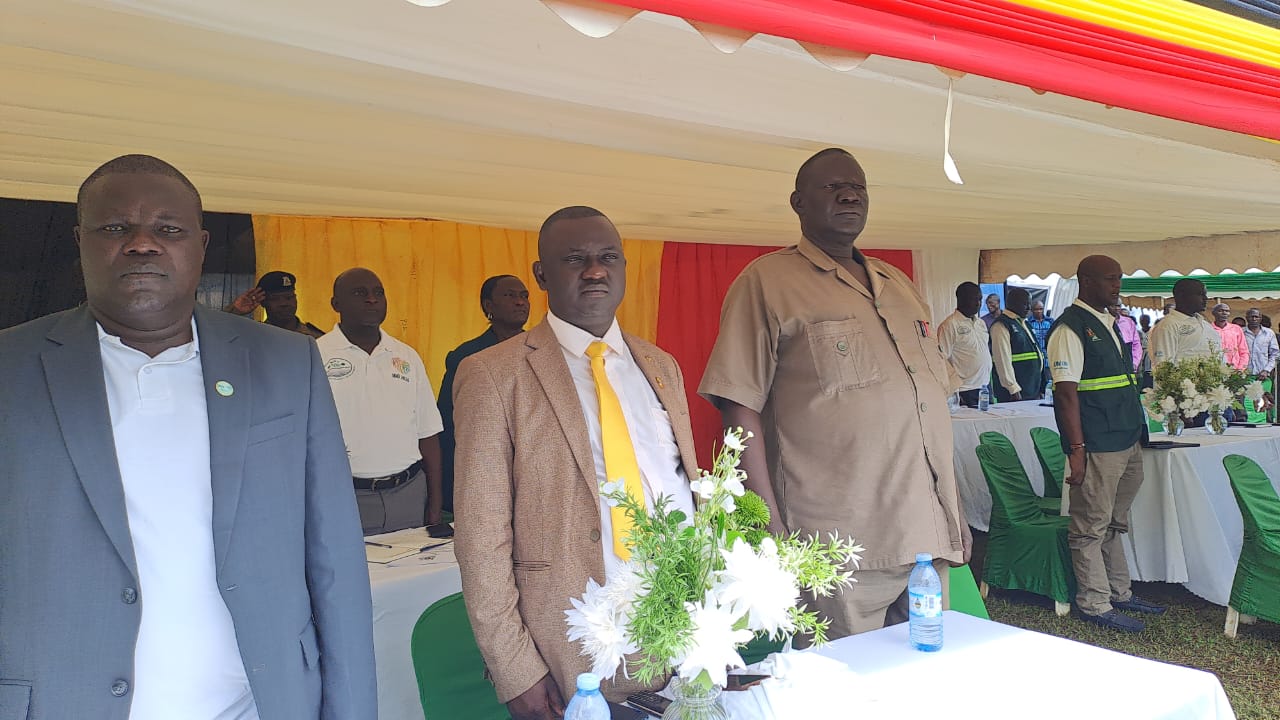
The celebration of this year’s IDB attracted high-profile national and district leaders, underlining the growing importance of biodiversity conservation in Uganda’s development agenda. The event was also graced by two other members of the NEMA Board: Dr. John Ekure, a respected medical entrepreneur and Chief Executive Officer of Kumi Orthopaedic Hospital, and Jimmy Kuka Chemonges, a widely respected son of the soil whose presence added local pride, warmth, and cultural connection to the national biodiversity celebrations.
NEMA Executive Director Dr. Barirega Akankwasah, was engaged in another environmental assignment in a different part of the country. He was ably represented at the celebrations by Francis Ogwal, the Commissioner for Environmental Planning and Coordination, who delivered the Authority’s message and reaffirmed NEMA’s commitment to biodiversity conservation and sustainable environmental management.
Also present were the RDC for Kapchorwa District and her team, the newly sworn-in LC5 Chairperson for Mbale District, and other community and civic leaders. Regional Manager for the Kyoga Water Management Zone Eng. Maximo B. Twinomuhangi was the chief guest who represented the Permanent Secretary, Ministry of Water and Environment.
William Lubuulwa is the Senior Public Relations Officer at NEMA.