


Environment
UNEP Report Calls for Sustainable Cooling to Curb Emissions, Save Trillions, and Protect Lives

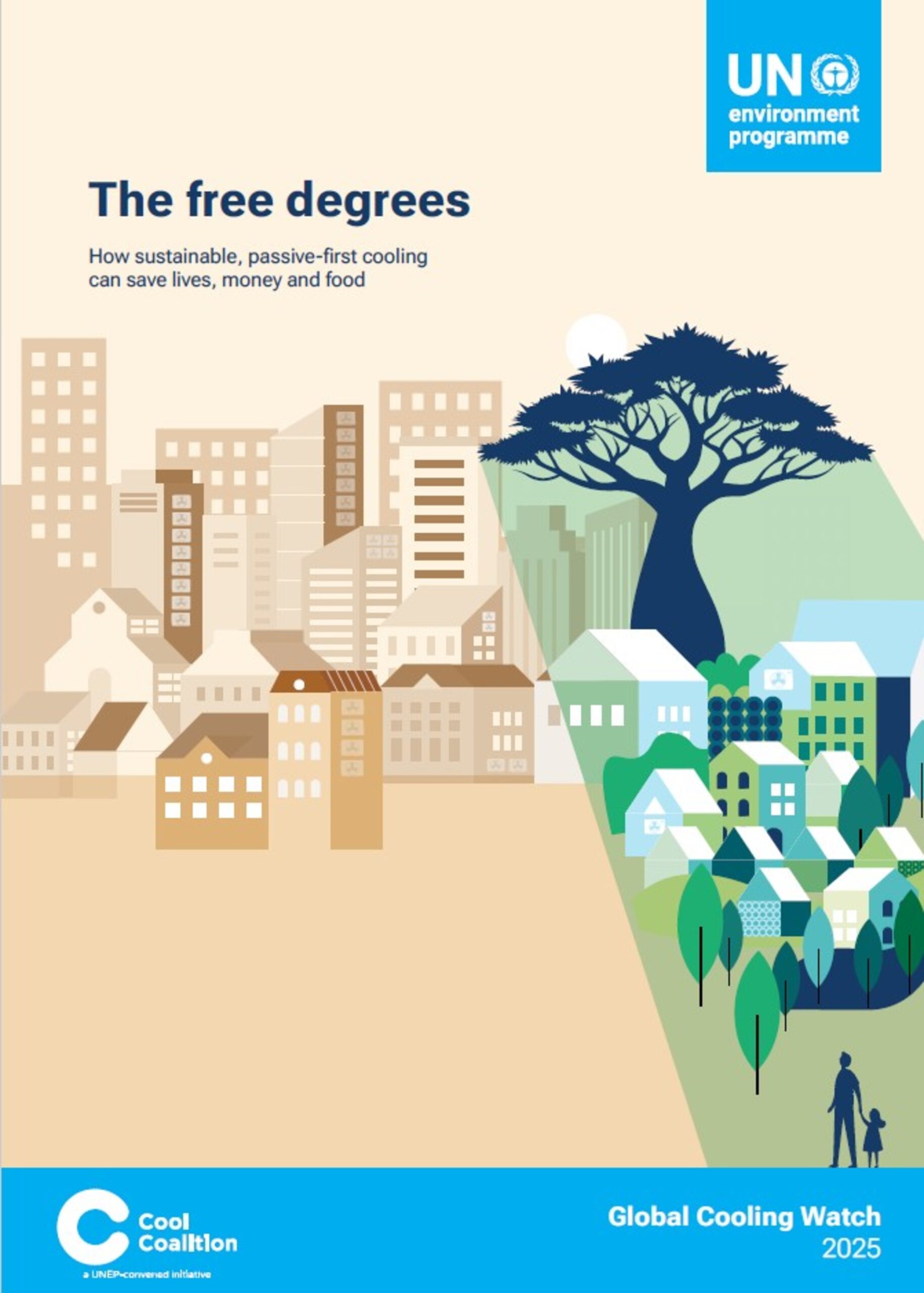
Belém, Brazil, 12 November 2025 — Amid rising heatwaves and surging global demand for cooling, the adoption of sustainable cooling solutions, especially passive, low-energy, and hybrid techniques combining fans and energy-efficient air conditioners, could drastically cut greenhouse gas emissions, save trillions of dollars, and expand life-saving access to cooling, according to a new United Nations Environment Programme (UNEP) report.
The Global Cooling Watch 2025, launched today at COP30 in Belém, Brazil, warns that cooling demand could more than triple by 2050 under a business-as-usual scenario. This surge will be driven by population growth, increasing wealth, more frequent extreme heat events, and rising access to inefficient, polluting cooling systems among low-income households.
If left unchecked, cooling-related emissions could nearly double from 2022 levels, reaching an estimated 7.2 billion tons of CO₂ equivalent by 2050, despite ongoing efforts to improve energy efficiency and phase down high-global-warming refrigerants. Such growth could also overwhelm power grids during peak demand periods.
The report outlines a “Sustainable Cooling Pathway”, capable of cutting projected 2050 emissions by 64 per cent, to 2.6 billion tons of CO₂ equivalent, and, with rapid decarbonization of the power sector, potentially achieving a 97 per cent reduction compared to business-as-usual levels.
“As deadly heatwaves become more regular and extreme, access to cooling must be treated as essential infrastructure alongside water, energy, and sanitation,” said Inger Andersen, Executive Director of UNEP. “But we cannot air-condition our way out of the heat crisis. Passive, energy-efficient, and nature-based solutions can help meet our growing cooling needs and keep people, food chains, and economies safe as we pursue global climate goals. We have no excuse, it’s time to beat the heat.”
Published by the UNEP-led Cool Coalition, the report provides the most comprehensive assessment to date of the world’s growing demand for cooling and the need for climate-friendly solutions.
The Sustainable Cooling Pathway envisions universal access to space cooling, refrigeration, resilient buildings, and urban green spaces, particularly for low-income and vulnerable groups such as smallholder farmers, women, and the elderly, without worsening the climate crisis.
It combines passive cooling strategies, low-energy and hybrid systems, high-efficiency equipment, and the phase-down of hydrofluorocarbon (HFC) refrigerants under the Kigali Amendment.
Nearly two-thirds of the available emission reductions come from passive and low-energy solutions, underscoring the need to embed these measures in national policies and urban planning. Such approaches are both cost-effective and essential for expanding cooling access to an additional three billion people by 2050.
If implemented, the Pathway could save up to US$17 trillion in cumulative energy costs and avoid as much as US$26 trillion in power grid investments through reduced electricity demand.
These measures form the foundation of the Mutirão Contra o Calor Extremo / Beat the Heat initiative, a joint effort by the Brazil COP30 Presidency and the UNEP Cool Coalition—to localize the Global Cooling Pledge and close policy, finance, and delivery gaps in heat resilience and urban cooling.
So far, over 185 cities, including Rio de Janeiro, Jakarta, and Nairobi, along with 83 partners, have joined Beat the Heat, alongside 72 Global Cooling Pledge signatories.
“Beat the Heat shows that mutirão, coming together for a shared cause, works,” said Ambassador André Corrêa do Lago, COP30 President-Designate. “It highlights the issue in an engaging way that inspires collective action against climate change.”
A total of 72 countries have joined the Global Cooling Pledge, committing to reduce cooling-related emissions by 68 per cent by 2050. By mid-2025, 29 nations had set specific greenhouse gas reduction targets for the cooling sector, with five more developing similar goals.
Overall, 134 countries have integrated cooling into their Nationally Determined Contributions (NDCs), National Adaptation Plans (NAPs), Long-Term Low-Emission Development Strategies (LT-LEDS), or energy and climate strategies.
However, only 54 countries have comprehensive policies covering all three key areas: passive cooling in building codes, minimum energy performance standards, and refrigerant transition. Seventy-eight countries cover two pillars, 40 cover only one, and 20 have yet to begin.
The largest gaps remain in Africa and the Asia-Pacific, where much of the future growth in cooling demand is expected.
The report recommends shifting from emergency response to proactive, multi-level governance on heat and cooling, treating cooling as a public good, and prioritizing passive and nature-based solutions, including urban design, to reduce cooling loads, ease grid stress, and mitigate the urban heat island effect.
What the leaders said:
H.E. Grace Fu, Minister for Sustainability and the Environment, Singapore
“As a Global Cooling Pledge signatory, Singapore is taking concrete steps toward implementation and proudly supports the Beat the Heat initiative by sharing our technical expertise in sustainable cooling and urban heat resilience. Through platforms like our Digital Urban Climate Twin, we aim to help cities worldwide model, predict, and mitigate urban heat, advancing practical, inclusive solutions for a cooler, more climate-resilient future.”
Dr. J. Jeyaranjan, Executive Vice-Chairman, State Planning Commission, Government of Tamil Nadu
“From declaring heat as a state-specific disaster to developing Heat Action Plans for major cities, Tamil Nadu has built a comprehensive model for heat governance. By joining Beat the Heat, we aim to learn from global experiences while sharing our own data-driven approaches, creating heat-resilient and inclusive cities.”
E. Evandro Leitão, Mayor of Fortaleza, Brazil: “Fortaleza is putting nature at the heart of climate adaptation. We are expanding green corridors and microparks to cool our city and protect the most vulnerable. This is about equity, health, and livability—and through Beat the Heat, we want to share and learn with cities worldwide.”
H.E. Lt. Gen. Bashir Mohamed Jama, Minister of Environment and Climate Change, Somalia
“For Somali cities like Dolow, Baidoa, Galkaio, and Bossaso, sustainable cooling is not a luxury—it is a lifeline. By joining Beat the Heat and collaborating with UNEP’s Cool Coalition, we aim to protect lives and livelihoods from intensifying heat while advancing our climate goals.”