


News
UMWA Releases Findings from the Global Media Monitoring Project 2025

Journalists in Uganda continue to face numerous challenges in the course of their work, forcing many to abandon the profession for careers they consider safer and more sustainable for their well-being.
These challenges include underpayment or working without pay, unfavorable working conditions such as lack of protective gear, harassment and torture by sources while in the field, violation of journalists’ rights by security officials, arrests and detention,
confiscation and destruction of equipment, and sexual harassment particularly affecting female journalists.
According to findings released by the Uganda Media Women’s Association (UMWA) during the Global Media Monitoring Project (GMMP) 2025, progress in women’s visibility and voice in the media has stagnated.
After a slow but steady rise over the years, growth began flattening in 2010, a trend that continues to date. During this period, there has been no significant improvement, nor notable backsliding, across most of the gender equality indicators monitored.
The report reveals that of the people seen, heard, or spoken about in print and broadcast news, only 26% are women. This represents a nine-percentage-point increase over 30 years, with only a two-point rise recorded in the latter half of that period. Additionally, women account for 41% of reporters in legacy news media an improvement from 1995, but still far from gender parity.
During Uganda Media Week 2025, UMWA presented further findings from the GMMP 2025, which aimed to measure gender balance in the media and identify who makes the news. The results showed that women remain underrepresented, accounting for only 23% of news subjects compared to 77% men. News sources comprised 29% women and 71% men, while newsroom staffing stood at 30% women and 70% men.
The First Secretary at the Swedish Embassy, Jessica Pellrud, commended UMWA for the findings and emphasized the need to create safe working environments for female journalists. She called for collective responsibility from media organizations, development partners, and civil society to ensure that women’s voices are not only amplified but also genuinely heard.
Meanwhile, Paulo Ekochu, Chairperson of the Uganda Media Council, highlighted the assaults journalists faced during the Kawempe by-elections earlier in 2025, where many sustained injuries. He noted that most of those injured lacked protective gear.
Ekochu challenged media house owners to prioritize the safety of their journalists by providing adequate protective equipment, stressing that proper safety measures are essential to safeguarding journalists while performing their duties.
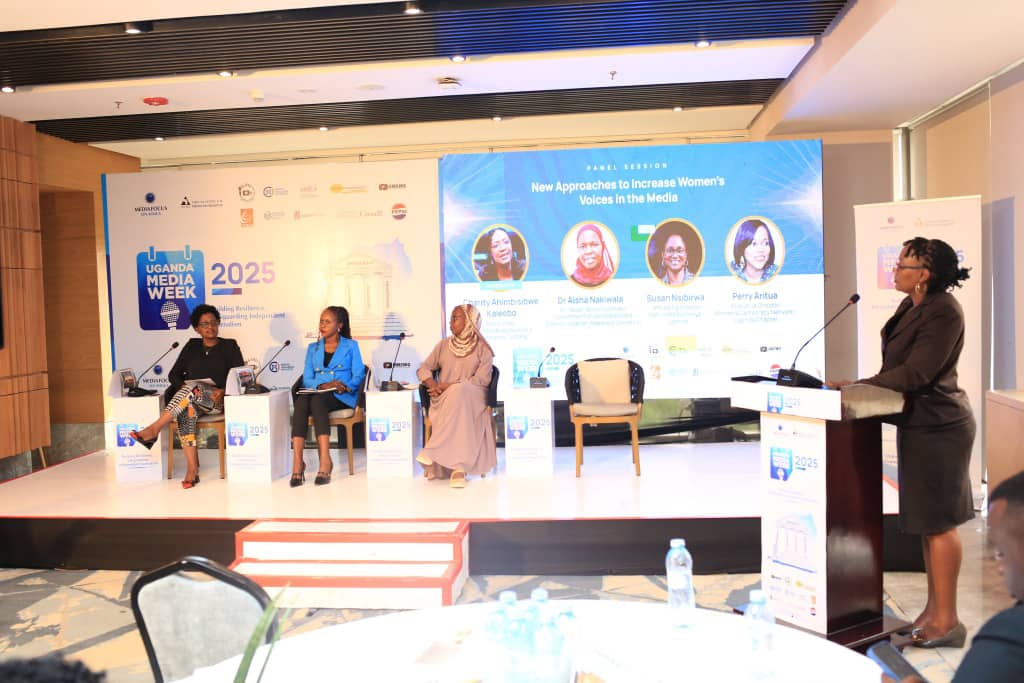
Different media personalities shared their views during a panel discussion on new approaches to increasing women’s voices in the newsroom. The discussion was moderated by the Board Chair of the Uganda Media Women’s Association (UMWA), Charity Ahimbisibwe Kalebu.
The Managing Director of Nation Media Group, Susan Nsibirwa, expressed concern over the rising attacks on journalists in the country, citing incidents during the Kawempe by-elections.
She noted that, beyond physical attacks, journalists particularly women continue to face violations such as sexual harassment from male colleagues. Nsibirwa emphasized the need for continued dialogue and action to improve the safety and well-being of journalists.
Perry Aritua, the Executive Director at Women’s Democracy Network-Uganda Chapter urged journalists to challenge societal norms that make women more vulnerable to harassment, pointing out that many women experience abuse without fully understanding their rights. She called on journalists to use their storytelling power to educate women about their rights, including what steps to take and where to report cases of harassment.
The Head of Communications at Makerere University, Dr. Aisha Nakiwala, expressed appreciation for the guidance being provided on amplifying women’s voices in the media. She highlighted the importance of training journalism students to recognize whose voices matter and to understand reporting from a gender perspective.
Dr. Nakiwala affirmed her commitment, on behalf of fellow gender trainers, to continuously review journalism curricula to ensure students are well equipped to report and tell stories in a gender-sensitive manner.
These and other critical conversations took place during Uganda Media Week 2025, held on 17 and 18 December 2025 at the Four Points by Sheraton Hotel in Kampala, under the theme “Building Resilience, Safeguarding Independent Journalism.”