


News
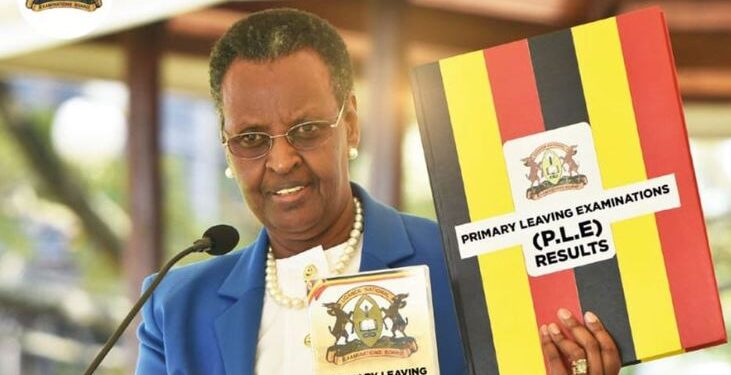
Uganda National Examinations Board Officially Releases 2025 Primary Leaving Examination Results

According to the 2025 Primary Leaving Examination (PLE) results, more learners passed in Division One compared to the 2024 PLE cycle.
However, the overall proportion of candidates who passed slightly declined compared to 2024. Notably, in absolute terms, more candidates successfully completed PLE in 2025 due to increased candidature.
A total of 817,883 candidates from 15,388 examination centres registered for PLE in 2025, compared to 797,444 candidates in 2024.
Of these, 522,036 candidates (63.8%) from 11,525 centres were beneficiaries of Universal Primary Education (UPE), while 295,847 candidates (36.2%) from 3,863 centres were Non-UPE learners.
Gender analysis shows that 389,469 boys (47.6%) and 428,324 girls (52.4%) were registered in 2025, indicating that more girls than boys completed the primary education cycle. This trend has persisted in recent years. In 2024, girls accounted for 52.5% of candidates, while boys accounted for 47.5%.
The Uganda National Examinations Board (UNEB) registered 3,636 learners with Special Needs Education (SNE) in 2025, compared to 3,328 in 2024—an increase of 308 candidates (9.3%).
These included learners who are blind, deaf, physically handicapped, and dyslexic. The increase has been attributed to heightened awareness in schools by UNEB and the Ministry of Education and Sports. Among SNE candidates, 48.3% were female and 51.7% male.
Additionally, UNEB registered 61 candidates from Uganda Government Upper Prison, Luzira (54 males and 7 females), and 40 candidates from Mbarara Main Prison (39 males and 1 female).
The First Lady expressed gratitude that a large proportion of candidates who sat the Primary Leaving Examinations last year are beneficiaries of Universal Primary Education (UPE), a government programme introduced 30 years ago.
She noted that this highlights the critical importance of UPE to Ugandan children, observing that since its inception, hundreds of thousands of children—who would otherwise have missed out on education due to school fees—have been able to complete primary education.
She welcomed the increasing number of girls completing the primary education cycle but expressed concern over the declining proportion of boys doing so.
She questioned whether this trend is purely demographic or whether more boys are dropping out of school, emphasizing the need for an evidence-based explanation to address the issue.
The First Lady reaffirmed the government’s commitment to Universal Primary Education, stating that with the renewed mandate of the NRM government by the people of Uganda, UPE will continue to expand access to basic education for all.
She emphasized that the government remains committed to ensuring that all children attend primary school free of charge, without any financial barriers.
She added that fully free UPE provides both an opportunity and a platform for all children to acquire the foundational learning that primary education is intended to deliver.
NEB Executive Director, Dan Odong, commended Chief Administrative Officers, as well as district and urban education officials, for working closely with UNEB to ensure that counterpart funding, logistics, and personnel were mobilized for the successful administration of the examinations.
He reported to the First Lady that some local governments still do not allocate budgets for conducting the PLE, relying solely on UNEB’s contributions.
In such districts, he noted that the shortage of funds severely constrains the proper conduct of the examinations. “I pray that, during this budgeting period, they remember to allocate some resources for this important cause,” he emphasized.
The Chairperson of UNEB, Professor Celestino Obua, reported to the Minister of Education on rising cases of examination malpractice. He noted that there has been an increased level of desperation among some school directors and headteachers.
Professor Obua explained that in certain instances, when examination distributors deliver question paper envelopes to schools, some headteachers, working with already compromised scouts, open the envelopes in advance to access the papers.
This is done to assist candidates before or during the examination. He further revealed that in some districts, even education officials are becoming complicit in these practices.