

Politics
President Museveni Pledges to Settle Obongi’s Development Debts, Fix Electricity and Roads

President Yoweri Kaguta Museveni has pledged to settle what he called the government’s “two major debts” to Obongi District, electricity connection and road infrastructure, assuring residents that the long-standing challenges of isolation and underdevelopment will soon be history.
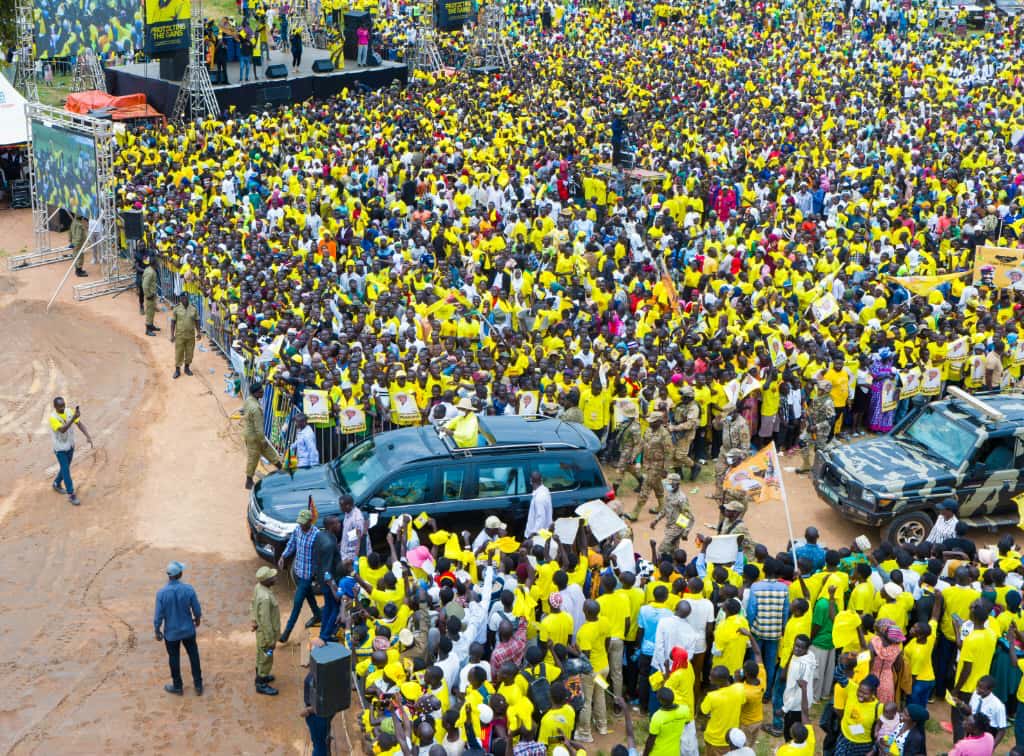
Addressing thousands of National Resistance Movement (NRM) supporters at Lionga Grounds, Obongi, on Friday, October 17, 2025, the President, who is also the party’s presidential flag bearer, said the government has already secured funding to bring electricity to the district and begin tarmacking its key roads within the current financial year.
“We have two debts with Obongi, and one is electricity. Money has been secured to bring electricity to Obongi. We are going to use a World Bank loan to do this,” President Museveni said.
“They’re now doing procurement, looking for the right company to do the work. That debt is paid because the money is already there,” he added.
The President noted that Obongi and Buvuma remain the only two districts in Uganda not connected to the national electricity grid, a situation he said would soon be corrected.
According to President Museveni, the construction of the power line connecting Obongi will commence before the end of the current financial year, marking a turning point in the district’s access to energy.
He also listed key road projects earmarked for upgrading, including the 132-kilometre Noko–Obongi–Adjumani–Owafa–Lubala–Kurikiringa Road, and another route linking Goli–Panyimur–Pakwach–Rhinocamp–Obongi, which he said would boost tourism along the Nile corridor.
“All these roads will be worked on, and Obongi will no longer be isolated,” he declared.
The pledge is part of a broader infrastructure push across the West Nile sub-region. The President highlighted ongoing or planned tarmacking projects such as the Manibe–Jule Road, Nebbi–Goli–Paidha–Zombo–Vura Road, and the Laropi–Moyo Road.
President Museveni used the occasion to reflect on Uganda’s infrastructure transformation under NRM leadership.
“When the NRM came into government, the tarmac road ended at Karuma on that side and Gulu on this side. Now tarmac has reached Koboko and Oraba, and from Gulu to Atiak, Adjumani to Laropi, Moyo, soon we shall link Adjumani and Obongi to these roads,” he said.
While pledging major road upgrades, President Museveni also criticized district authorities for failing to maintain existing murram roads despite the availability of government equipment.
“Even if the road is not tarmacked, it should be maintained in good condition and passable. In West Nile, we have two government stations in Arua and Moyo, with all the necessary road equipment, graders, rollers, bulldozers, tippers. You wonder why the roads remain impassable. If somebody is sleeping, I’m going to wake them up,” he said.
The President urged local leaders to take responsibility for regular road maintenance, saying neglect undermines government investment.
He recalled his early familiarity with Obongi’s challenges, dating back to the 1980s when the area was still part of Moyo and Adjumani districts.
“When I came into the government, I was aware of the isolation of Obongi. It was part of the Moyo and Adjumani districts. Although their population was small, I said no, these people need their own corner. So, we gave you a district deliberately because of geography and isolation,” he said.
Obongi District, officially created in 2019, now has a population of about 142,000 people, according to the 2024 census. President Museveni said his return was both to “remind residents of NRM’s past commitments” and to present the party’s new manifesto.
The NRM Manifesto: Peace, Unity, and National Strength
The President told supporters that the NRM’s 2026 manifesto is built on seven core pillars, focusing on three—peace, development, and wealth creation.
“The first one is peace,” H.E. Museveni emphasized, noting that despite wars in neighboring countries, Uganda remains an island of peace because NRM’s politics unite Ugandans not by religion or tribe, but by what one can do for the country.
He attributed stability to the NRM’s deliberate effort to build inclusive national institutions, such as the army, police, and civil service, that draw personnel from all regions of the country.
“One of my commanders, the late Maj. Gen. Hussein Adaa, was from this region and commanded the headquarters in Bombo,” President Museveni recalled.
“That’s why when recruiting, we make sure every district has a quota. That’s how we built a strong army that guarantees peace.”
He warned against what he termed “bad politics” from opposition parties, saying the NRM’s ideology of unity has been the foundation of peace and economic growth.
Health and Education
Turning to social services, President Museveni praised Obongi’s progress in healthcare but acknowledged remaining gaps in two sub-counties that still lack health facilities.
Out of six sub-counties in the district, one has a Health Centre IV, three have Health Centre IIIs, while two have none. The President pledged to fill the gap by upgrading Obongi Health Centre IV to a General Hospital and upgrading Indilinga HCII (in Aliba) and Lomunga HCII (in Gimara) to HCIIIs.
“We are going to solve that by building Health Centre IIIs and a district hospital,” he said, noting that such interventions have contributed to population growth from 20,000 in 1980 to over 142,000 today.
He credited immunization and improved healthcare for the demographic growth, saying, “In the 1980s, many children were dying after birth because there was no immunization. I’m happy we have moved a long way.”
The President also restated his position against charging school fees in government schools, urging residents to hold school management committees accountable.
“Some school committees claim they lack teachers and charge parents to pay extra staff, but I’m going to recruit 50,000 additional primary school teachers to close that gap,” he said.
Obongi currently has 24 government primary schools, 62 private ones, two government secondary schools, and 21 private secondary schools. Two seed secondary schools are under construction, which will reduce the number of sub-counties without a government secondary school from four to two.
He also highlighted vocational training initiatives under the State House Skilling Programme, citing the Olia Skilling Hub in Adjumani District, where youth have been trained in tailoring, carpentry, and joinery.
The Resident District Commissioner (RDC) of Obongi, Mr. Samuel Mpimbaza Hashaka, informed the President that Shs. 50 million had already been deposited in Centenary Bank to support skilling hub graduates through a SACCO.
Wealth Creation for Prosperity
Shifting focus to the economy, President Museveni urged residents not to confuse public infrastructure with personal wealth, saying both are necessary but distinct.
“You don’t sleep on a tarmac road at night. In Kampala, there are roads, electricity, and internet, yet people still live in ghettos,” he said. “So please don’t be diverted by development and forget wealth creation.”
He traced the evolution of the NRM’s household income programs, from Entandikwa and NAADS to Operation Wealth Creation, Emyooga, and now the Parish Development Model (PDM), which he described as the most comprehensive of all.
According to official figures presented at the rally, Obongi District’s 28 parishes have cumulatively received Shs. 8.6 billion under the PDM programme. Of this, Shs. 8.36 billion, representing 99.43 percent, has already been disbursed to 8,891 beneficiary households.
With 30,171 households in total, the President said the remaining 21,280 households would also be reached as the programme expands.
He promised to maintain the annual PDM allocation of Shs. 100 million per parish, with additional funding for special groups.
“I will add Shs. 15 million for leaders who have not been borrowing from this small SACCO. We shall also have funds for religious and cultural leaders, and for university graduates who fail to get jobs within two years of completing school,” he announced.
The President further revealed plans to introduce a fish farming project in the district to help households generate higher incomes, citing examples from Limoto, where fish farmers earn up to Shs. 100 million annually.
Political Support and Outlook
NRM Vice Chairperson for the Northern Region, Hon. Denis Hamson Obua, commended President Museveni for transforming Obongi from a county to a district in 2019, describing him as “a guarantor of peace and a champion of development.”
“In just six years, Your Excellency, the government has injected over Shs. 209 billion into Obongi,” Hon. Obua said. “In the last financial year alone, the district received Shs. 17 billion.”
Obongi’s LC5 Chairperson and NRM District Chairperson, Abibu Buga Khemis Awadi, assured the President of overwhelming support in the 2026 elections.
“In 2021, you got 65 percent of the vote in Obongi. In 2026, we are promising 90 percent,” Awadi declared.
Residents also petitioned the President to construct a bridge connecting Obongi and Adjumani to improve transport and trade across the Nile.
According to electoral statistics, Obongi had 19,321 registered voters in 2021, of whom 12,883 (66.7 percent) voted. President Museveni received 7,676 votes (64 percent), followed by the National Unity Platform candidate with 2,769 votes (23 percent).
By 2025, the district’s voter register had grown to 25,171, with polling stations increasing from 44 to 59, a 34 percent rise, reflecting population growth and improved access.
Obongi currently comprises six sub-counties and town councils, 28 parishes, and 151 villages.