


Politics
Museveni Pledges Special Consideration for Acholi in Cattle Compensation Program

The ruling NRM Party Presidential candidate, Yoweri Kaguta Museveni, has promised that the government will give special consideration to the Acholi under the new format of the cattle compensation program, which will soon be rolled out across the Acholi, Lango, and Teso sub-regions.
The program seeks to redress the historical loss of livestock and wealth suffered by families during the insurgencies that ravaged Northern Uganda for decades.
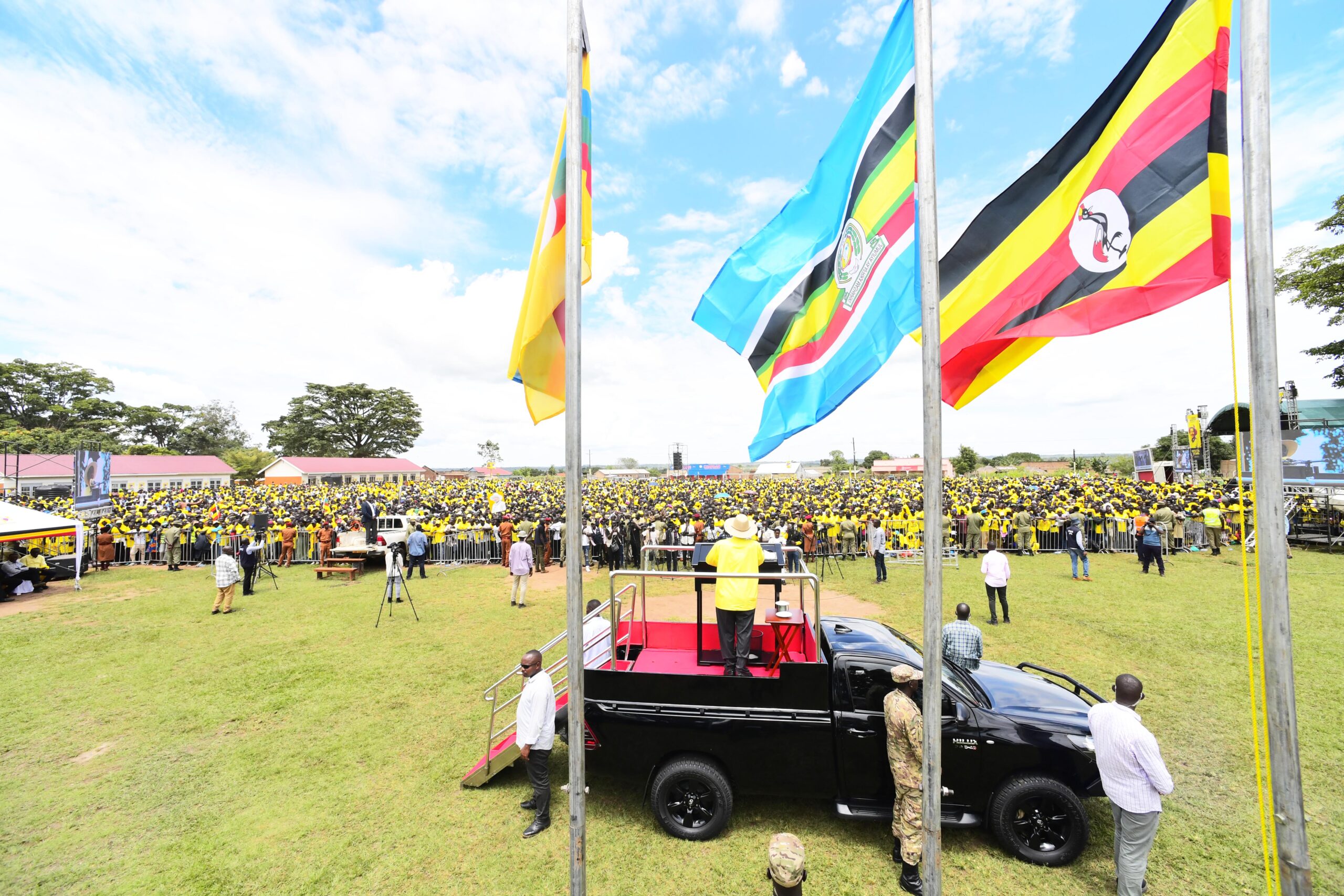
Addressing thousands of supporters during a campaign rally at Opit Primary School playgrounds in Omoro Town Council, Omoro District, President Museveni, who is also the NRM presidential candidate, said the government had reviewed the previous cattle compensation framework and agreed to adopt a fairer and more transparent approach that guarantees inclusivity for all affected households.
“When the delegation from Acholi came, they said Acholi suffered the most and the longest during the insurgencies. Therefore, in addition to the five cows per household, we should also deal with genuine claimants who lost much more,” President Museveni said.
“I’m glad we have agreed on the minimum of five cows for the entire area, and Cabinet will also study the idea of variation for the Acholi sub-region,” he added.
The President explained that while the government had already spent Shs 159 billion on compensation claims across the three regions, many of the beneficiaries were questionable, and the process lacked transparency.
“The cattle in this area were destroyed by wars, and we tried to restock. But some players opened up a case in the courts of law against the government. Because I never like wars, I decided to discuss with them, and they started getting money from the government to pay their clients. Up to 159 billion shillings was spent in that exercise,” he said.
“But where did this money go? I started checking and discovered theft and other irregularities in the payment model. The majority of the homesteads were left out.”
President Museveni revealed that after consultations with leaders from Teso, Acholi, and Lango, it was agreed that every homestead should receive five cows under a harmonized model to ensure equitable distribution.
According to government statistics, 4,836 claimants in the Acholi sub-region have so far been compensated, including 583 in Omoro District who received Shs 5.6 billion.
The President used the rally to highlight the NRM’s legacy of peace and stability, describing it as the foundation upon which Uganda’s progress has been built. He urged the people of Acholi to continue supporting him and all NRM flag bearers to consolidate these gains.
“The NRM has been able to maintain peace in Uganda for the first time in a long period, and the reason we were able to do so is because of good politics,” he said.
President Museveni cited two major pillars of the NRM’s achievements: peace and development. Under development, he emphasized both economic infrastructure—such as roads, electricity, telecommunication, and water supply—and social infrastructure like schools and health facilities.
“We have already constructed tarmac roads in Acholi in three directions, including the road from Karuma to Pakwach, Karuma to Gulu up to Nimule, and the road from Olwiyo–Gulu–Kitgum–Musingo,” he said.
“These are roads that never existed before. The road from Gulu to Awere to Kona Kilak will also be done. I know it very well because I used it many years ago. Other roads we are going to work on include the road from Kitgum to Palabek to Atiak,” he added.
The President also reflected on Uganda’s oil discovery, attributing it to divine timing and NRM leadership.
“God did not allow the British to discover our petroleum. They were here for 68 years and gave up in 1956 despite clear signs. When we came, we discovered it, and it’s going to start flowing next year,” President Museveni declared.
“Once we get our oil, these roads and other projects will be much easier to implement, but we must continue prioritizing rather than touching everything at once.”
On education and health, President Museveni expressed satisfaction with the government’s investments in Omoro District, where there are now eight government secondary schools—compared to the early 1960s when such facilities were extremely scarce.
“In 1961, when I was at Ntare School, there were many boys from Acholi studying there because, at that time, there were only six schools with A-Level,” he recalled, mentioning schools such as Kisubi, Buddo, and Ntare for boys, and Namagunga, Nabbingo, and Gayaza for girls.
He added that then, other famous schools like Nyakasura, Sir Samuel Baker, Teso College, and Busoga College Mwiri were only O-Level.
“Now, to hear that Omoro has eight secondary schools with A-Level makes me very happy. That’s progress, and we’re continuing to see more. That’s the second contribution of the National Resistance Movement,” he said.
Omoro District currently has 67 government primary schools, 81 private primary schools, 8 government secondary schools, and 11 private secondary schools. The newly completed secondary school in Lakwana Sub-County has reduced the number of sub-counties without government secondary schools from eight to seven.
However, the President cautioned that while infrastructure is important, true progress comes when households generate wealth.
“Do you sleep on the tarmac road at night or in school? You sleep in your home, and you need money, wealth in your home, to live a good life,” he said. “That’s why we emphasize that all Ugandans must get involved in wealth creation.”
President Museveni reiterated that development without household wealth leads to dependency. He traced Uganda’s economic empowerment journey through government programs such as Entandikwa, NAADS, Operation Wealth Creation (OWC), Emyooga, and now the Parish Development Model (PDM).
He said PDM was specifically designed to help those at the bottom of the economic pyramid, citing a success story from Omoro.
“Anena, one of the PDM beneficiaries, received one million shillings, planted groundnuts, harvested 35 bags, and earned over two million shillings. She bought goats, which are multiplying, and even purchased a sewing machine worth 900,000 shillings. She now rents a room for 40,000 a month and is earning daily,” the President said.
“This program is not for rich people like Otema or Museveni but for those who need to start. The rich can go to UDB Bank, but beginners need PDM.”
He warned against corruption and misuse of the PDM funds, stressing the government’s commitment to close monitoring.
“Please follow it up; nobody should steal or play around with it. We are adding another 15 million shillings for local leaders at the parish, bringing the total to 115 million shillings per parish. We also want to start a fund for religious and cultural leaders according to their parishes or Muslim districts,” he announced.
According to official figures, Omoro District’s 65 parishes have cumulatively received Shs 19.96 billion in PDM funds, of which 99.77% has been disbursed to 19,920 beneficiary households. Out of 46,805 households, 26,885 are yet to benefit, including those already in the money economy.
Additionally, both constituencies in Omoro have 28 Emyooga SACCOs with 7,993 members. The government has disbursed Shs 1.3 billion, with member savings totaling Shs 48.7 million.
President Museveni also emphasized the importance of vocational training and artisanship as pathways for job creation. He cited testimonies from graduates of the Gulu Industrial Skilling Hub, including Ivan from Palenga, who studied welding and metal fabrication and now operates his own workshop at Palenga Trading Centre.
“These young people had lost hope because their families couldn’t afford school fees. But now, they are making products like shoes, which we used to import from China, India, and Italy,” he said.
“This is why, in the coming government, we must stop charging school fees in government schools,” he added.
He criticized the commercialization of education and revealed plans to recruit more teachers to strengthen free education.
“Some teachers say we don’t have enough staff, yet we can plan better. We should spend our money on classrooms, laboratories, libraries, and teachers’ houses rather than expensive boarding sections. Education should be accessible and affordable for all,” he said.
The President noted that real job creation comes from commercial agriculture, artisanship, and industrialization, not just government employment.
“Government jobs are very few. Only 480,000 people are employed by the government out of a population of 46 million Ugandans,” he said.
As a model example, he cited Hon. Fred Byamukama, Minister of State for Transport, who practices the four-acre model in Kakumiro District.
“Byamukama grows coffee, bananas, and fruits and keeps poultry. From eggs alone, he earns 55 million shillings per month, about 600 million shillings annually, and employs 26 people. That’s how wealth creation produces jobs,” the President said.
The Government Chief Whip and NRM Vice Chairperson for Northern Uganda, Hon. Denis Hamson Obua, welcomed President Museveni to Omoro and praised his leadership for restoring peace and advancing development in Acholi.
“Your Excellency, the people of Omoro are here to thank you for restoring peace, championing development, and introducing wealth creation. Omoro District is ready to compete with other districts in ensuring they lead in voting for you and all NRM flag bearers,” Hon. Obua said.
The NRM Electoral Commission Chairperson, Dr. Tanga Odoi, who represented the party’s Secretary General, lauded Omoro for what he described as one of the largest turnouts during President Museveni’s northern Uganda campaign tour.