


Gender
Increase in Female Genital Mutilation Cases Raises Global Alarm

Despite sustained global efforts to eliminate female genital mutilation/cutting (FGM/C), experts continue to express concern over its rising prevalence. Recent estimates indicate a 35% increase in reported cases, particularly across 13 countries in South and Southeast Asia.
These countries include India, Pakistan, Sri Lanka, and the Maldives in South Asia, as well as Vietnam, Cambodia, Thailand, Brunei, Singapore, the Philippines, Indonesia, Malaysia, and Azerbaijan in South-East Asia.
FGM/C has no medical or health benefits, and no scientific evidence supports the practice. Nevertheless, some health professionals in parts of Asia continue to perform the procedure, thereby medicalizing and wrongly legitimizing it as “safe” or “beneficial.” This medicalization undermines global efforts to eradicate the practice and perpetuates harm under the guise of healthcare.
All world leaders committed to eliminating FGM/C by 2030 under Sustainable Development Goal (SDG) target 5.3. They also pledged to advance menstrual health and hygiene under SDGs 3, 4, 5, and 6, ensuring that “no one is left behind.” With 58 months remaining to meet the 2030 deadline, progress remains insufficient.
Experts warn that current efforts fall far short of what is required to achieve these targets. Millions of women and girls particularly in parts of Asia remain at risk. FGM/C can lead to severe health complications, including infections, chronic pain, childbirth complications, sexual dysfunction, and profound psychological trauma.
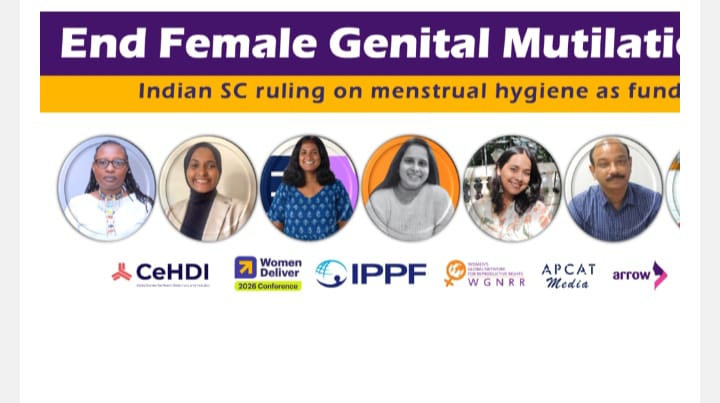
During a SHE & Rights session held in February 2026 ahead of the 70th session of the United Nations Commission on the Status of Women (CSW70), speakers described FGM/C as one of the most serious forms of gender-based violence and a grave violation of human rights.
They emphasized that ending the practice is essential to fulfilling global commitments to gender equality, bodily autonomy, and human dignity.
According to Shobha Shukla, Host of SHE & Rights and Executive Director of CNS, world leaders committed at the 2015 United Nations General Assembly to eliminate female genital mutilation/cutting (FGM/C) by 2030 under Sustainable Development Goal (SDG) 5.3.

However, despite this global pledge, the number of women and girls affected has increased by 15% over the past eight years from an estimated 200 million in 2016 to more than 230 million in 2024. She noted that approximately one-third of all FGM/C cases occur in Asia, affecting nearly 80 million women and girls.
Safiya Riyaz of the Asia Network to End FGM/C emphasized that leading medical and scientific authorities have issued clear and explicit condemnations of the medicalization of FGM/C.
These include the World Health Organization (WHO), the International Federation of Gynecology and Obstetrics, the International Confederation of Midwives, and the United Nations Population Fund, among others.
Riyaz further explained that documented complications of Type I FGM also practiced in parts of Asia can be severe.
These include intense pain, genital swelling, haemorrhage, infections, and other serious short- and long-term health consequences. She stressed that even the so-called “less severe” forms of FGM can result in significant physical and psychological harm.
Divya Srinivasan, Global Lead for End Harmful Practices at Equality, highlighted that this SHE & Rights session coincides with the 20th anniversary of the Universal Periodic Review (UPR).
“We have found the UPR mechanism extremely valuable,
For instance, it enabled the issuance of the first-ever recommendation to India on female genital mutilation/cutting (FGM/C) from an international mechanism, helping to keep the issue current.” She said
Srinivasan also noted a rising anti-rights pushback in several countries. “In The Gambia, there have been attempts to repeal the anti-FGM/C law. Similarly, in the United States, there are efforts to misuse anti-FGM/C legislation to target gender-affirming care,” she explained.
Shobha Shukla also elaborated on the UPR as a unique, State-driven mechanism of the UN Human Rights Council that periodically reviews the human rights records of all 193 UN Member States.
The UPR operates in 4.5-year cycles of interactive, peer-reviewed dialogues, allowing countries to highlight progress and receive targeted recommendations aimed at improving human rights globally.
“Let us make accountability mechanisms like the UPR more effective in ensuring gender equality and the human right to health for every person, leaving no one behind,” Shukla emphasized.
An FGM/C Survivor’s Call to End FGM, a form of Gender-Based Violence
Catherine Menganyi, HSC nurse-epidemiologist, survivor of female genital mutilation/cutting (FGM/C), and a passionate advocate for ending all forms of gender-based violence in Kenya, shared her deeply personal journey:
“My journey to ending FGM/C did not begin in an office. It began where the pain is felt most deeply through personal experience,” Catherine explained. “As a young girl, I was subjected to FGM/C.
That was the first turning point of my life the pain and psychosocial trauma remain vivid even today. But now, I take that experience as an opportunity to protect thousands of girls I have worked with, guiding them so they never undergo the cut.”
“As both a survivor and a nurse-epidemiologist, I understand the severe physical and psychological harms caused by FGM/C,” she said. “The solutions must be community-led and community-owned.
Affected communities understand why harmful practices continue and are best placed to design locally relevant, effective interventions. Investing in community-led responses is the most sustainable way to end FGM/C.”
Catherine emphasized that FGM/C is not an isolated issue. “It is part of a broader system that controls women’s and girls’ bodies, restricts their choices, and normalizes violence against them. We cannot separate FGM/C from the wider problem of gender-based violence. Promoting gender equality is not optional it is a fundamental right for all women and girls.”
She concluded with a powerful reminder: “Every girl and every woman has the right to grow up whole, safe, educated, and free from violence. Ending female genital mutilation/cutting is not charity it is justice.”