


Gender
Global Pushback on Gender Equality Threatens Progress at CSW70

This year’s priority theme under discussion is, ‘Ensuring and strengthening access to justice for all women and girls, including by promoting inclusive and equitable legal systems, eliminating discriminatory laws, policies, and practices, and addressing structural barriers.
However, for the first time in the 70 years’ history of CSW, the outcome document was adopted via a formal vote rather than by consensus, a retaliatory stand taken by the U.S.
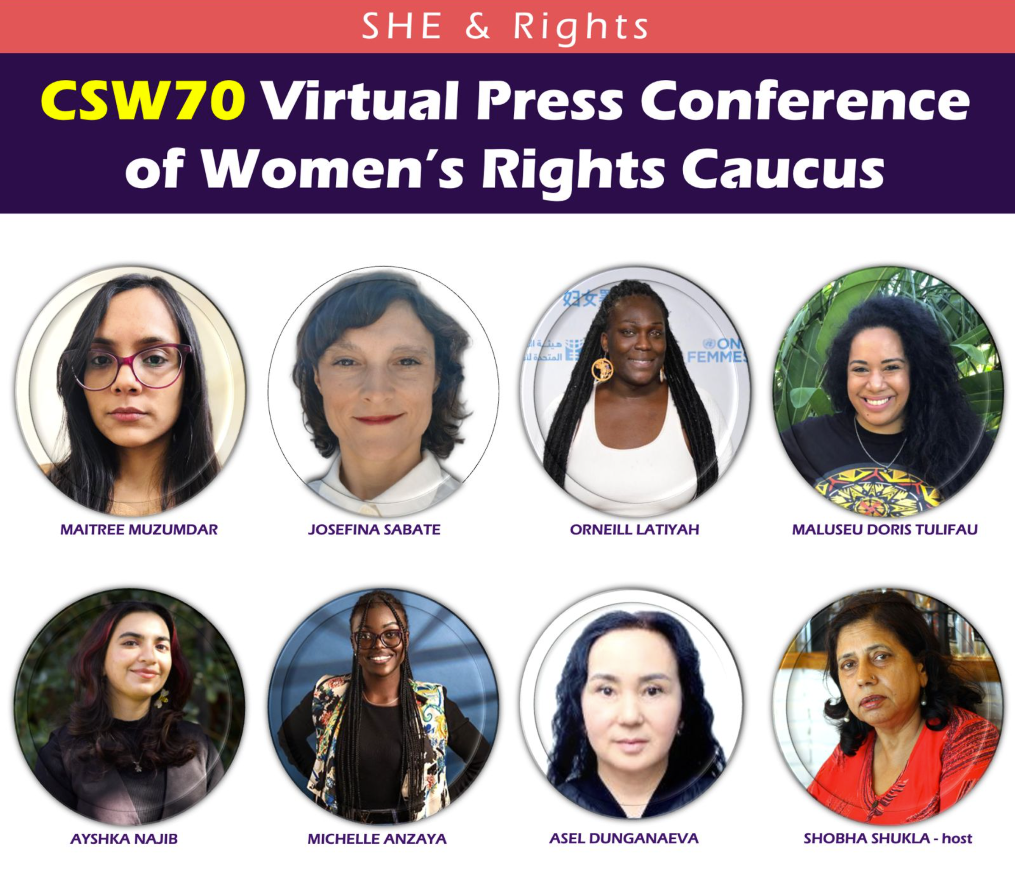
According to the Host of SHE & Rights (campaign to advance gender equality and human right to health) and Founder Executive Director CNS, Shobha Shukla, USA introduced eight oral amendments aimed at altering the draft text to align with its own positions on issues including abortion, gender identity, and diversity, equity and inclusion.
When these amendments were defeated by other UN Member States or countries (by a vote of 26 to 1, with 14 states abstaining) the U.S. forced a recorded vote on the entire document.
She added that Ultimately, the CSW70 document was adopted with 37 votes in favour and 1 against (the United States), and 14 abstentions (including Nigeria, Egypt, and Saudi Arabia).
This rare break from consensus to a vote highlights widening global political divides over gender rights and is a sign of increasing pressure and pushback against existing human rights language, particularly regarding gender equality.
Maitree Muzumdar co-founder Feminist Manch and co-convener of the Young Feminist Caucus and the Women’s Rights Caucus agreed that, CSW70 negotiations took place amid a global rollback of rights, shrinking civic space, rising authoritarianism and militarism, and deepening economic crisis, and lamented that “member states approached access to justice as a technical issue rather than a political issue, focusing on procedural reforms without addressing the structural conditions that produce injustice which allows governments to avoid confronting the political interests and power relations that sustain injustice.
Maitree emphasised that in many contexts, states themselves are responsible for serious human rights violations through misuse of security laws, policing, and impunity of armed forces used to justify repression and criminalization against communities demanding justice.
These patterns of repression also appear in laws that criminalize LGBTI communities, regulate women and gender diverse people’s bodies such as through restrictions on abortion, and render people illegal.
While opening as a keynote speaker at a press conference hosted by Women’s Rights Caucus around 70th Session of the UN Commission on Status of Women (CSW70), Maitree noted that there has also been reluctance to address the impunity of the private sector in the privatization of essential public services, climate injustice, human rights violations, and development projects that “deepen inequalities between countries and people, which harms are closely tied to development models that prioritize economic growth and profit over people’s rights.
Yet, these models remained unquestioned, making strong corporate accountability and reparative remedies essential.
Argentine feminist activist, who is also part of the Political Advocacy unit at FUSA Asociacion Civil, Josefina Sabate, agreed that that the political process (CSW70) has taken place in a highly adverse political context and the CSW70 outcome document is not as progressive as we might have wished. For her “access to justice is not merely a technical matter.
Women and girls face numerous obstacles – legal, financial, geographical, and institutional barriers – that hinder their access to justice, bodily autonomy, sexual and reproductive health services, and mechanisms for redress and reparation.
“However, this agenda faces significant resistance in Latin America. Many countries in this region stand in opposition to this agenda. Colombia, fortunately, is one of the few nations in the region that continues to champion these rights”, said Josefina
Ayshka Najib, a climate and gender justice advocate and co-convener of the Young Feminist Caucus, rightly pointed out that at CSW70 many western countries that called for ensuring access to justice and gender equality for all women and girls, were the same countries aiding and abetting billions of dollars in military violence and occupation in global south countries, displacing and murdering millions of women and girls
She rightly pointed out that “justice for women and girls is systematically obstructed by patriarchal, militarized, and fascist systems manifested through war economies, arms trade, corporate capture, and fossil fuel-based extractive models that dispossess indigenous communities.
Achieving justice requires the dismantling of these systems, redistribution of power, demilitarization, protection and expansion of civic spaces, and the meaningful leadership of feminist movements”
Similarly, Maluseu Doris Tulifau, a Samoan feminist and founder of Brown Girl Woke, shared the travails of Pacific women – women with disabilities, LGBT+ communities, migrants, and rural women – who continue to face multiple intersecting barriers to justice.
She explained that “From a Pacific perspective, justice is not experienced through a single system. Women navigate a continuum of justice systems: formal courts, customary governance, faith-based authority, and family negotiation.
For most of the Pacific women, particularly in rural, remote, and outer island communities, customary and community-based justice mechanisms remain the primary entry point for justice.
In addition, the press briefing featured contributions from several other speakers, including: Asel Dunganaeva, social development specialist from Kyrgyzstan, the communications professional and feminist leader from Africa Michelle Anzaya, the Global Advocacy Officer at Fòs Feminista,Shiphrah Belonguel, and the Deputy Executive Director, Asian-Pacific Resource and Research Centre for Women (ARROW) Sai Jyothirmai Racherla.